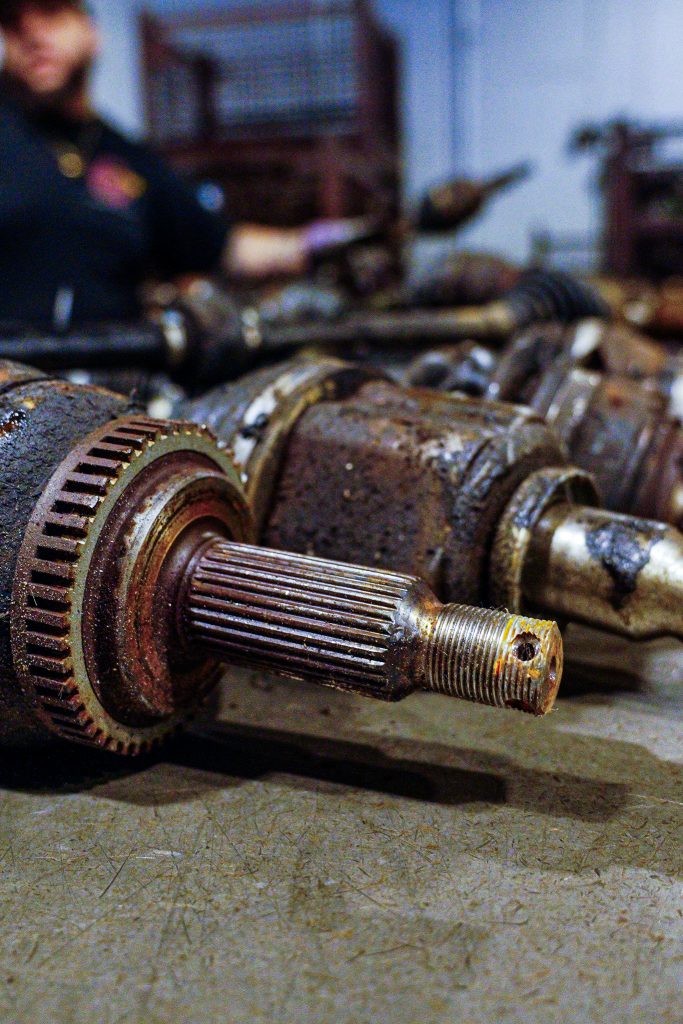
If you only go to the grocery store with a list that says milk, bread, and butter, that’s all you’ll ever eat. A lot of core programs work the same way. Someone wrote a short list years ago (alternators, starters, A/C compressors, maybe calipers) and the team pulls it from every vehicle, every time.
It feels efficient. It isn’t. The most profitable core programs I’ve seen do the opposite: they look at the data first, then send labor only after the cores worth pulling.
Old school vs. new school
| Old school | New school | |
|---|---|---|
| Starting point | A fixed list of parts | The VIN and live core values |
| Who decides | The parts puller in the field | The inventory person at the desk |
| Labor | Spent on every part on the list | Spent on the parts worth pulling |
| Payoff | Unknown until the statement arrives | Known before the wrench comes out |
Old-school thinking says pull the cores we want and expect a big payday. New-school thinking says assess the vehicle by VIN, cherry-pick the best values, and match them to the labor you have. The first burns a lot of labor for an unknown return. The second sets the value up front and gets more bang for the buck.
A real example: the four-part list
I consulted with a small company that was pulling a four-part list from every single vehicle. They thought they were saving time. They were smart people, just doing things the way they’d always done them.
I let them keep pulling until we had data from several orders, and the data showed two problems:
- They were missing the money. Their list skipped steering, advanced electronics, brakes, and other cores with much higher values.
- They were pulling zeros. With only four part types, when one of them lost its core value, 25% of everything they pulled was worth nothing.
When we sat down with the reports, I thought the parts puller was going to have a meltdown. He saw how much of his time had gone into parts with zero value. But the fault wasn’t his. He was doing exactly what he’d been told.
The team switched to cherry-picking from a longer list. Their next core box came in at double the previous value.
Your inventory person is your best core picker
My general rule: I would rather spend brain energy sifting through inventory data than waste physical labor pulling parts with low or zero value.
The person entering your vehicles already has what they need. In any yard management system, quantity on hand (QOH), days on hand (DOH), and request and sales history tell you whether a part belongs on the shelf or in the core box. Add the VIN-based core value, and the decision takes seconds.
That’s how some parts never make it to the shelf at all. If you already have three of the same alternator sitting there, the fourth one goes in the core box when the vehicle is dismantled.
Even parts you don’t stock for resale belong on your electronic list. Many recyclers don’t inventory calipers for the counter. Add them anyway, so you can cherry-pick the high-value ones instead of pulling every caliper and diluting your average.
Why printed lists don’t work anymore
When someone asks me for “a list of cores you’re buying,” I know they’re still in old-school mode. Printed lists are out of date by the time they come out of the printer. Core values change, and new part numbers come into demand.
There’s a difference between a printed list and the parts a core buyer is searching for right now. The new-school inventory person wants data now, by VIN, at the moment the vehicle is checked in.
How a VIN-based workflow looks
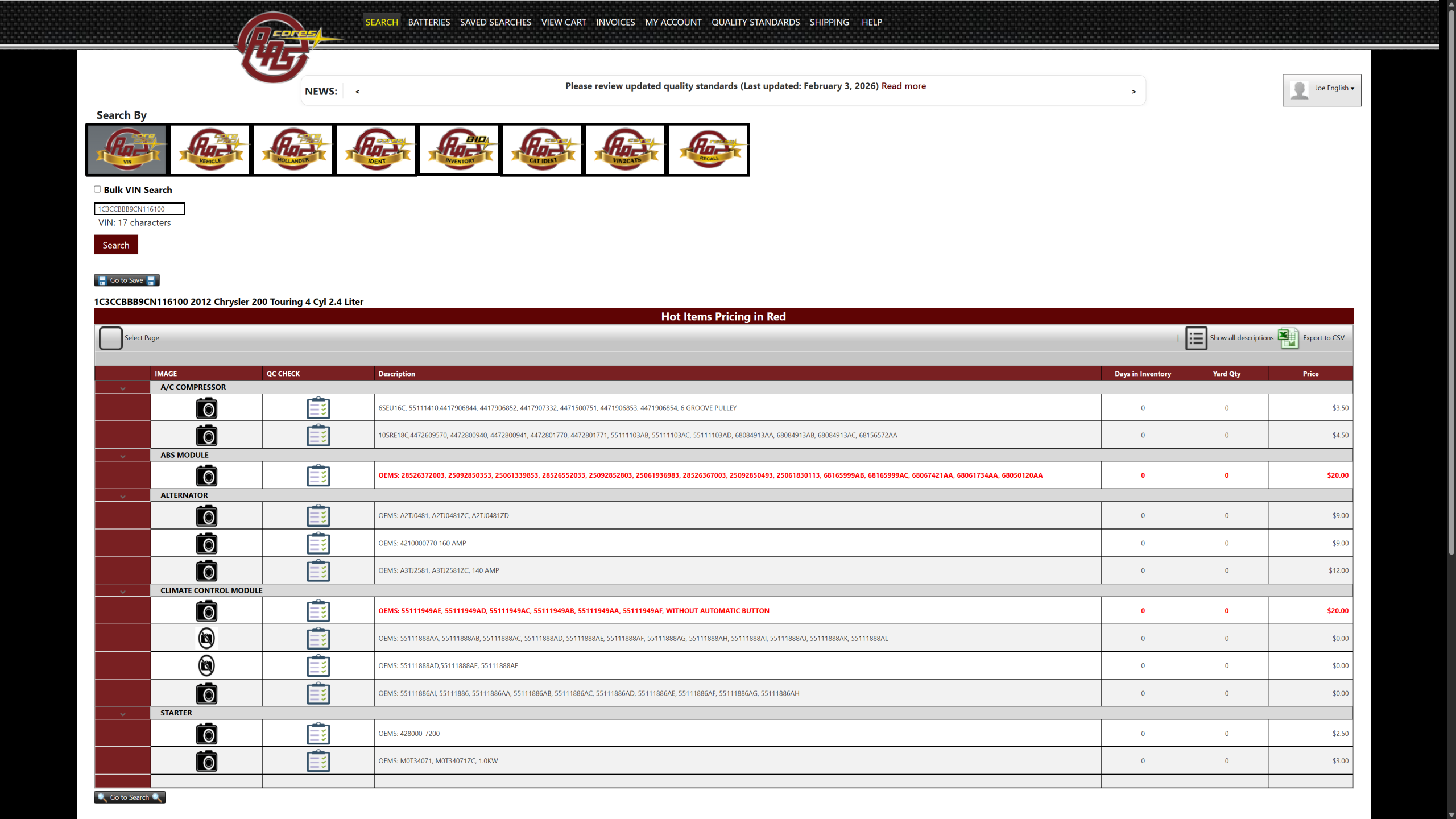
Every core buyer’s software is a little different. With RAS CorePro on web and mobile, the flow has three steps:
- Search. Run the VIN and see which cores on that vehicle have value.
- Saved search. Check the parts worth pulling and save them under the stock number. Think of this as the work order. After the parts are removed, verify the part or casting number and update the saved search. This is your quality check.
- Cart. Move the finished saved search to the cart. The cart represents everything in your gaylord and on your core rack, ready to pack, invoice, and ship.
In a full-service yard, the inventory person runs the search, the dismantler or core technician removes and verifies the parts, and either one moves it to the cart.
Put a core charge on more than the basics
Cherry-picking applies at the counter too. Every big-box parts retailer charges a core on the parts it sells. Many recyclers only charge cores on alternators, starters, and A/C compressors. If you’re selling a rack and pinion, why wouldn’t you want the returned core back? Steering, brakes, ABS modules, and advanced electronics often carry far more core value than the basics.
A word on local core vendors
I have nothing bad to say about local core vendors. They usually give good service and pay cash on the spot. But they typically buy a short list in bulk at an average price. You get cash in hand, and you give up the high-dollar cores that would have paid more on their own. If you sell to a local buyer, sell them the low-value parts and cherry-pick the rest.
Think big, and think profitably
Cherry-picking isn’t more work. It’s less work, aimed better. Start with your next ten vehicles: run every VIN, pull only what pays, and compare the average value per part to your last box. The numbers will make the case for you.
Read more: Cores Are a Contact Sport: Five Contact Points for Cores in Your Workflow
Back to the full guide: Auto Core Competency
See what your vehicles are worth in cores. Request a CorePro demo or talk to the RAS cores team.